
What Does MOQ Mean in Packaging?
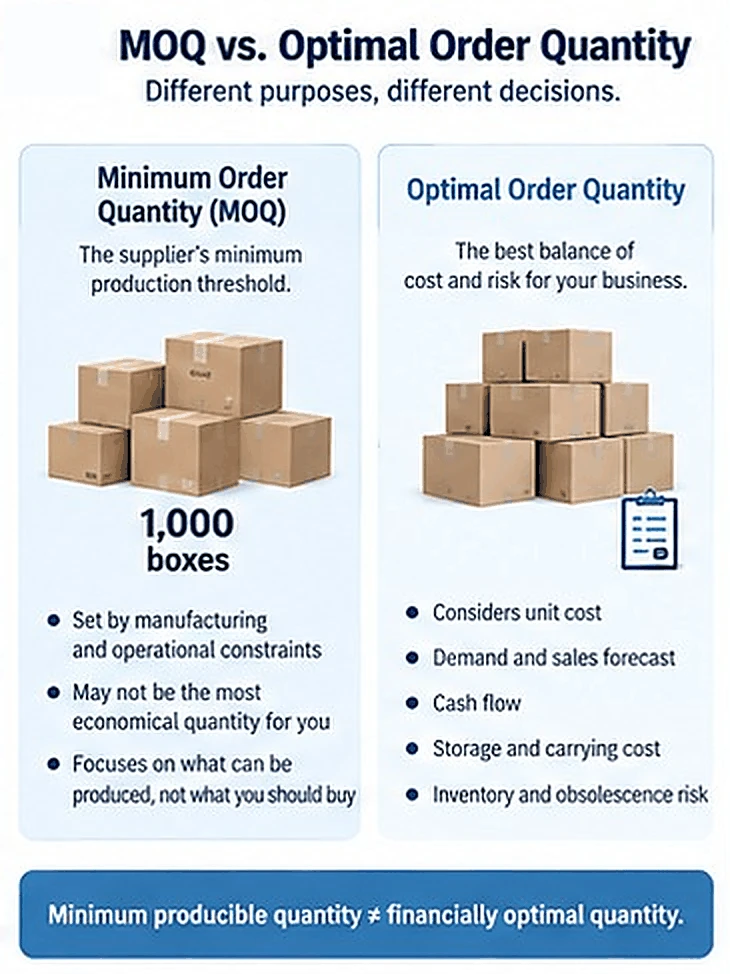
MOQ, or minimum order quantity, is the smallest quantity of packaging a supplier is willing or able to produce for an order.
For example, if a custom box supplier has an MOQ of 1,000 units, an order for 500 boxes may not be available even at a higher unit price.
A packaging MOQ may come from manufacturing constraints or from the supplier's commercial policy. It should be viewed as a production threshold-not necessarily the quantity that makes the most financial sense for the buyer.
MOQ vs. Minimum Order Value
MOQ refers to a minimum number of units, while minimum order value (MOV) refers to a minimum dollar amount.
For example, 500 boxes at $4.50 each would total $2,250 and meet a $2,000 MOV. But if the production MOQ is 1,000 boxes, the order would still be too small.
|
Requirement |
Meaning |
Example |
|
MOQ |
Minimum quantity |
1,000 boxes |
|
MOV |
Minimum order value |
$2,000 |
A supplier may apply one or both requirements.
MOQ vs. the Optimal Order Quantity
Meeting the MOQ does not mean you should order exactly that amount.
MOQ defines the supplier's minimum production threshold, while the best order quantity depends on unit cost, demand, cash flow, storage, and inventory risk.
Minimum producible quantity ≠ financially optimal quantity.
|
Concept |
Meaning |
|
MOQ |
Minimum production threshold |
|
Unit Price |
Cost per packaging unit |
|
Optimal Order Quantity |
Best balance of cost and risk |
To understand why suppliers set these minimums, the next step is to look at the manufacturing costs behind them.
Why Do Packaging Manufacturers Have MOQs?
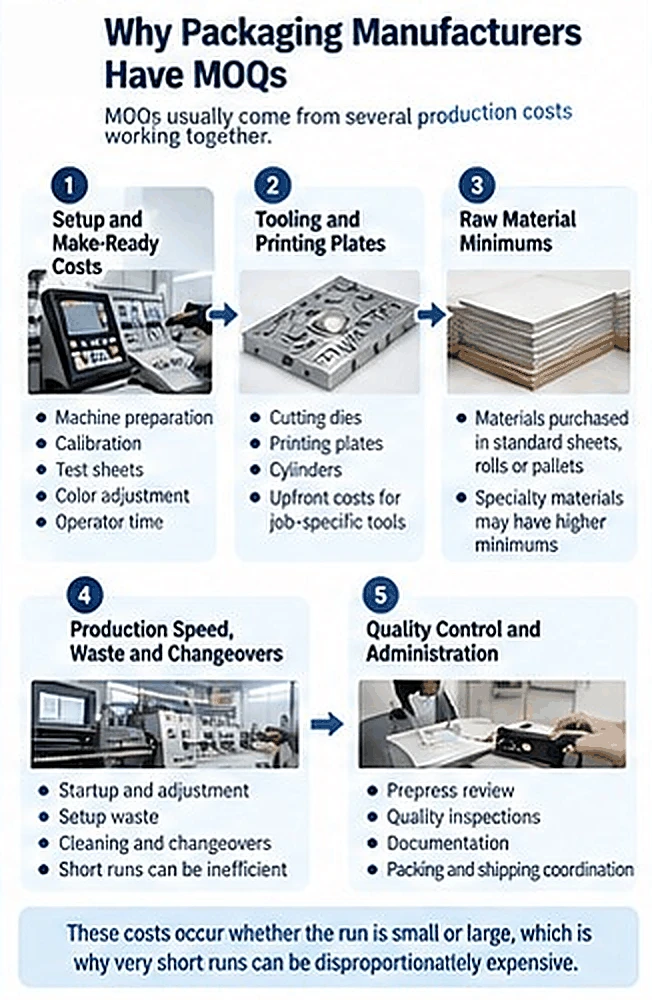
Packaging MOQs usually come from several production costs working together-not from a single rule.
The main factors are setup, tooling, material requirements, machine efficiency, and operational or quality-control overhead. Many of these costs occur whether the run is small or large, so very short production runs can be inefficient or disproportionately expensive.
Setup and Make-Ready Costs
Packaging setup costs may include machine preparation, calibration, test sheets, color adjustment, and operator time.
These costs are mostly fixed for each production run, which means they are spread across the total quantity:
Setup Cost per Unit = Total Setup Cost ÷ Order Quantity
If setup costs $500, the setup cost equals $1.00 per unit on a 500-unit run, but only $0.10 per unit on a 5,000-unit run.
Tooling and Printing Plates
Some packaging projects also require job-specific tooling, such as cutting dies, printing plates, or cylinders.
These upfront costs can make very small runs uneconomical. However, some tooling may be reusable for future orders, depending on the process and supplier.
A useful question to ask is:
Can this tooling be reused for repeat orders?
Raw Material Minimums
Materials can create another production constraint.
Paperboard, corrugated sheets, films, and other substrates are often purchased in standard sheets, rolls, pallets, or supplier-defined minimum quantities. Specialty materials may have higher purchasing minimums than commonly stocked materials.
For example, a standard white paperboard may be readily available, while a specialty metallic or custom-colored substrate may require a much larger material commitment.
Production Speed, Waste, and Changeovers
Industrial packaging equipment is designed to operate efficiently once a production run is underway.
Short runs still require startup, machine adjustment, cleaning, and changeovers. They may also generate setup waste before full-speed production begins.
If 100 sheets are lost during setup, that waste represents 20% of a 500-sheet run but only 1% of a 10,000-sheet run.
This is one reason very short production runs can carry a higher cost per usable unit.
Quality Control and Production Administration
Small orders still require planning and administrative work.
A production job may involve prepress review, work-order preparation, quality inspections, documentation, packing, and shipping coordination regardless of whether the run contains 500 units or 5,000.
These costs may be less visible than materials or tooling, but they still contribute to the minimum quantity a manufacturer can produce economically.
Together, these factors explain why packaging manufacturers use MOQs. The next question is more specific: what determines the MOQ for your particular packaging project?
What Actually Determines Your Packaging MOQ?
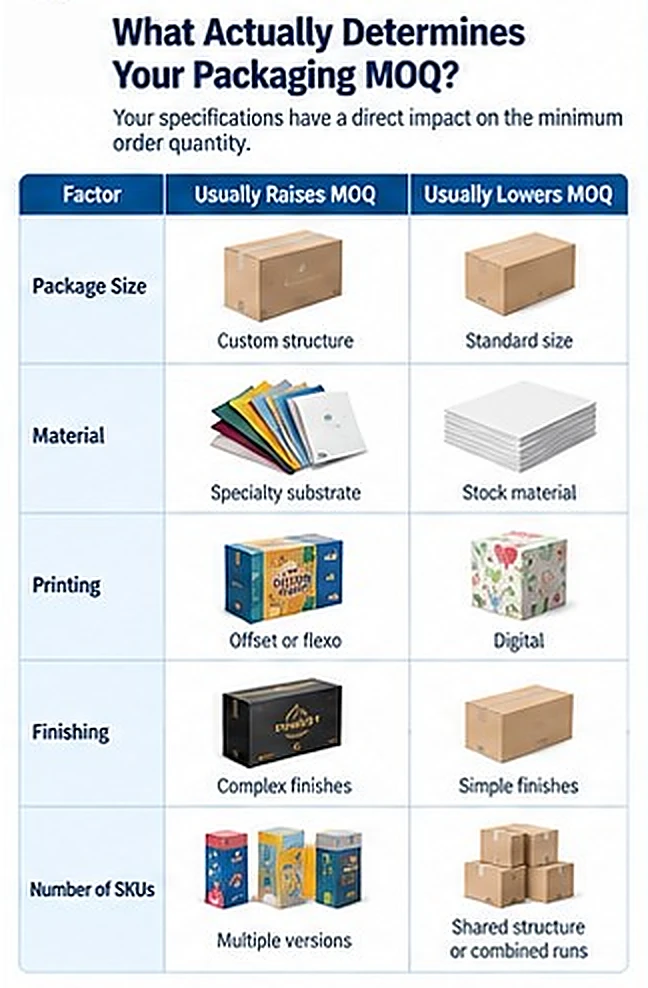
Your packaging MOQ depends on the project specifications, not just the supplier's general policy.
|
Factor |
Usually Raises MOQ |
Usually Lowers MOQ |
|
Size |
Custom structure |
Standard size |
|
Material |
Specialty substrate |
Stock material |
|
Printing |
Offset or flexo |
Digital |
|
Finishing |
Complex finishes |
Simple finishes |
|
SKUs |
Multiple versions |
Shared structure or combined runs |
Packaging Type
Corrugated boxes, folding cartons, rigid boxes, flexible packaging, and labels use different materials, machinery, and production steps.
That means their MOQs cannot be compared directly. The packaging type sets the basic production requirements behind the minimum quantity.
Printing Method
Printing method can have a major impact on MOQ.
Digital printing usually requires less setup, while offset and flexographic printing often become more economical at higher volumes.
However, substrate, size, color requirements, finishing, and supplier equipment can all affect the final MOQ.
Material Availability
Stock materials are generally easier to use for shorter runs.
Specialty colors, coatings, thicknesses, or custom substrates may need to be purchased specifically for your project, which can increase the minimum production quantity.
Size and Structure
Custom sizes may require new tooling or additional setup.
If the supplier already has a suitable die or similar structure, a lower-volume run may be easier to produce.
A useful question is:
Does the supplier already have tooling for a similar size?
Finishing Complexity
Special finishes such as foil, embossing, lamination, or spot UV can add tooling, setup, or secondary processing.
The more production steps involved, the more likely the MOQ is to increase.
Number of SKUs and Artwork Versions
A total order of 5,000 units does not always equal one 5,000-unit production run.
For example:
1 SKU × 5,000 units ≠ 5 SKUs × 1,000 units
Each design may require separate setup or changeovers.
In some cases, shared structures, common materials, or gang printing can help combine versions and reduce production constraints.
These factors explain why one project may have an MOQ of 500 units while another requires several thousand.
Typical MOQ Ranges by Packaging Type
Packaging MOQ varies widely by product type and production method. The figures you receive from a supplier will also depend on size, material, printing, finishing, and available equipment.
|
Packaging Type |
Typical MOQ Level |
Main MOQ Driver |
Low-Volume Alternative |
|
Corrugated boxes |
Low to medium |
Size, printing, tooling |
Digital print or standard sizes |
|
Folding cartons |
Medium |
Printing, board, die cutting |
Digital printing |
|
Rigid boxes |
Medium to high |
Manual assembly, tooling, finishing |
Simplified structure |
|
Flexible packaging |
High |
Film, cylinders, production setup |
Digital flexible packaging |
|
Labels |
Low to medium |
Printing method, material, finishing |
Digital labels |
These ranges should be treated as general benchmarks, not fixed industry standards. A custom box MOQ that works for one supplier may be very different from another supplier's minimum.
Why Your Quote May Fall Outside the Typical Range
Your MOQ may be higher or lower depending on factors such as:
custom materials or colors
special finishes
non-standard dimensions
multiple artwork versions
printing method
supplier equipment and production capacity
For the most accurate comparison, ask suppliers for pricing at several quantity levels rather than looking at MOQ alone.
The next question is why those quantity changes can have such a large effect on unit price.
Why Does Unit Price Drop When Order Quantity Increases?
Packaging unit cost often falls as order quantity increases because fixed setup costs are spread across more units.
Here is a simplified example using an $800 setup cost and a $0.60 variable cost per unit:
|
Quantity |
Setup Cost per Unit |
Variable Cost per Unit |
Simplified Unit Cost |
|
500 |
$1.60 |
$0.60 |
$2.20 |
|
1,000 |
$0.80 |
$0.60 |
$1.40 |
|
2,500 |
$0.32 |
$0.60 |
$0.92 |
|
5,000 |
$0.16 |
$0.60 |
$0.76 |
|
10,000 |
$0.08 |
$0.60 |
$0.68 |
The biggest savings happen as the fixed cost is spread across the first few increases in volume. After that, the cost curve begins to flatten and each additional increase produces smaller savings.
This is only a simplified illustration. Real packaging quotes may also include tooling, waste, freight, margin, finishing, and volume-based material pricing.
Most importantly, a lower unit cost does not automatically mean a lower total business cost.

MOQ Is Not the Same as the Best Quantity to Order
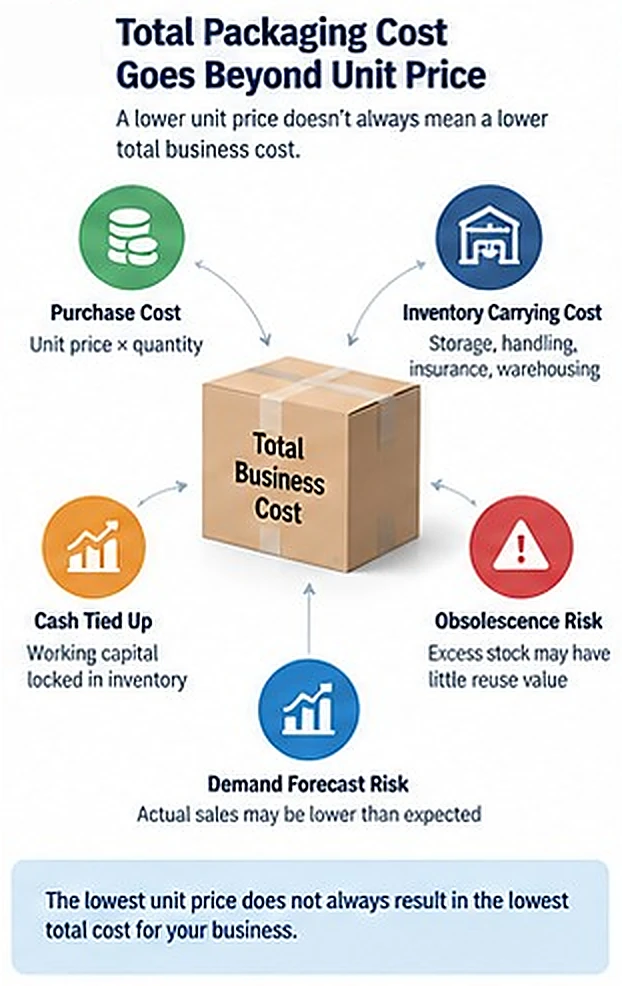
The supplier's MOQ tells you the minimum quantity available for production. The best quantity for your business depends on a broader cost picture:
Purchase cost + carrying cost + cash exposure + obsolescence risk + forecast risk
A larger order may reduce unit price while increasing inventory and financial risk.
Inventory Carrying Cost
Extra inventory has ongoing costs, including storage, handling, insurance, and internal warehouse management.
When comparing quantities, look at the additional cost of holding the extra units-not just the saving per box.
Cash Tied Up in Inventory
A larger order also requires more cash upfront.
For example, buying 5,000 units instead of 1,000 may reduce the price per unit, but it also commits significantly more working capital before those units are actually used or sold.
For cash-sensitive businesses, that trade-off can matter more than the unit-price saving.
Obsolescence Risk
Custom packaging can become unusable if branding, product information, regulations, or product specifications change.
Because printed packaging is often specific to one product or SKU, excess stock may have little reuse value once a change occurs.
Demand Forecast Risk
Obsolescence is not the only risk. You may simply order more packaging than future demand requires.
This is especially relevant for product launches, seasonal products, and new brands with limited sales history.
|
Option |
Main Advantage |
Main Trade-Off |
|
Low MOQ / Higher Unit Cost |
Lower cash and inventory exposure |
Higher cost per unit |
|
High MOQ / Lower Unit Cost |
Better production economics |
More cash, storage, and demand risk |
The right quantity is therefore not always the one with the lowest price per unit.
The next question is: when does paying more per unit for a lower MOQ actually make business sense?
When Does a Low MOQ Make More Sense?
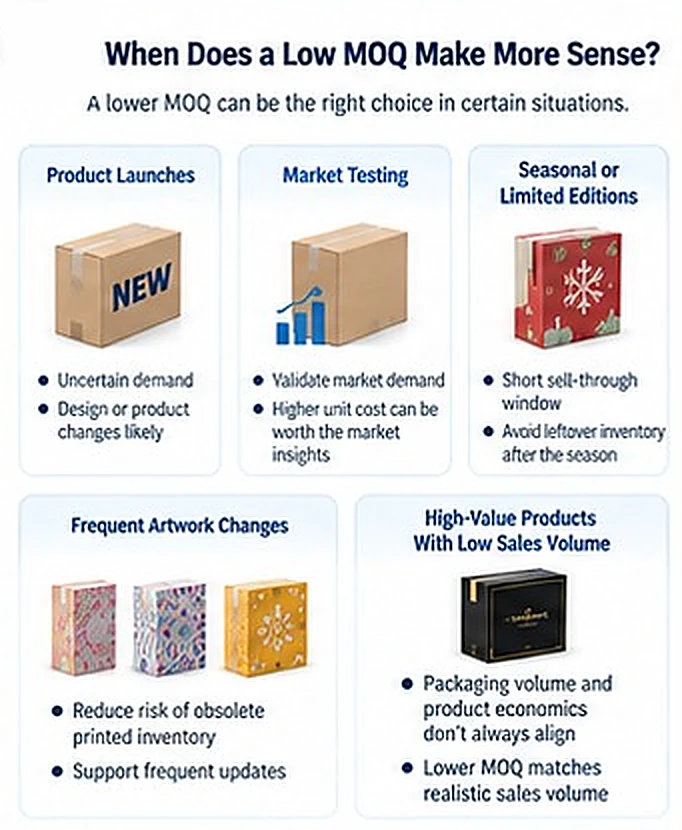
A lower MOQ can make sense when reducing inventory exposure matters more than achieving the lowest possible unit price.
Product Launches
New products come with uncertain demand and a higher chance of design, labeling, or specification changes.
A lower MOQ limits the amount of packaging committed before real sales data is available.
The trade-off is a higher unit price. The main question is whether the extra cost per unit is lower than the risk of holding obsolete packaging.
Market Testing
For a test launch, higher packaging cost can be treated as part of the cost of validating demand.
A smaller run lets the buyer collect real sales feedback before committing to a larger production quantity.
The trade-off is weaker unit economics, so the test quantity should still be large enough to generate useful market data.
Seasonal or Limited Editions
Seasonal packaging has a short sell-through window.
A lower MOQ can reduce leftover stock after the promotion or season ends, even if the per-unit packaging cost is higher.
The key is to compare unit savings from a larger order with the risk of unsold or unusable packaging.
Frequent Artwork Changes
Brands that regularly update graphics, claims, product information, or regulatory text face higher obsolescence risk.
Lower quantities reduce the amount of printed inventory exposed to future artwork changes.
The main trade-off is higher production cost per unit.
High-Value Products With Low Sales Volume
Some premium or specialized products generate strong margins but sell in relatively small quantities.
In these cases, a low packaging MOQ may be more practical than buying several years of packaging simply to reduce unit cost.
The key is to match packaging volume to realistic product demand.
8 Practical Ways to Reduce Your Packaging MOQ
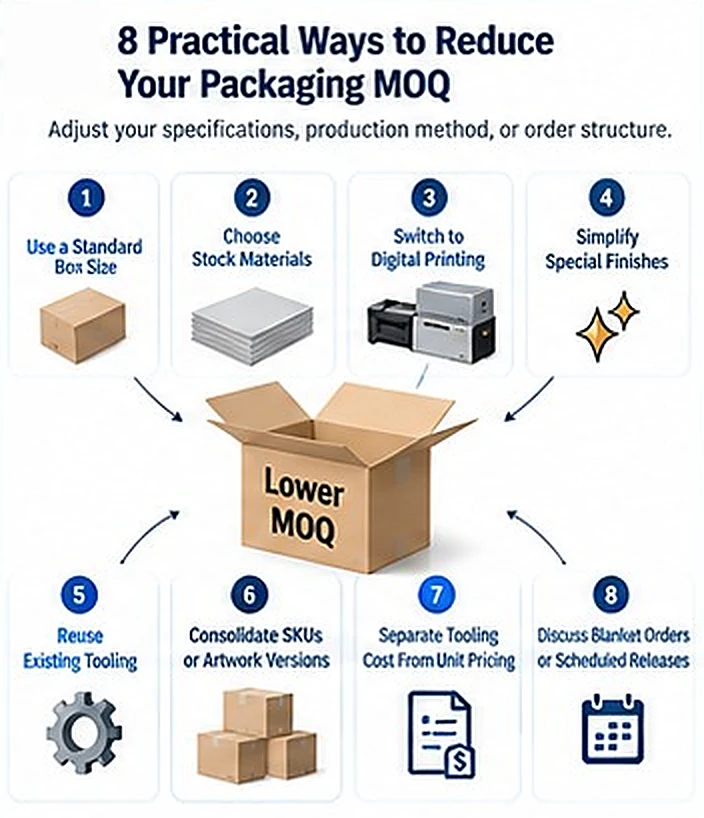
If your supplier's MOQ is too high, the most effective approach is usually to identify what is driving it and then change that specific production constraint.
Use a Standard Box Size
Standard sizes may allow the supplier to use existing tooling or familiar production setups.
The trade-off is less freedom in product fit, shipping efficiency, or visual differentiation.
This works best when a small size adjustment does not affect product protection or presentation.
Choose Stock Materials
Stock materials are already available within the supplier's normal purchasing system, which can make shorter runs easier to produce.
The trade-off may be fewer choices in color, thickness, coating, or sustainability specifications.
Use this approach when material customization is less important than order flexibility.
Switch to Digital Printing
Digital printing can reduce plate-making and setup requirements, making it suitable for shorter runs.
However, a lower MOQ does not always mean a lower cost at higher volumes.
It is most useful when quantity is limited, artwork changes frequently, or multiple versions are required.
Simplify Special Finishes
Processes such as foil stamping, embossing, lamination, or spot UV may introduce additional setup and minimum processing requirements.
Removing or simplifying one finish can reduce production complexity.
The goal is not to eliminate premium features automatically, but to identify which finishes are commercially necessary and which add cost without enough value.
Reuse Existing Tooling
If a supplier already has a suitable die or other tooling, reusing it may avoid new setup costs.
Ask:
Can existing tooling be used for this size or structure, and can it be reused for future orders?
This works best when small structural adjustments are acceptable.
Consolidate SKUs or Artwork Versions
Multiple SKUs can create separate setup requirements even when the total order volume is high.
Using shared dimensions, materials, or structural designs may make it easier to combine production.
Some suppliers may also support versioned or gang production, but this depends on their equipment and process.
This is especially useful for brands with many related SKUs.
Separate Tooling Cost From Unit Pricing
Sometimes the MOQ is partly driven by the supplier's need to recover tooling or setup costs.
In that case, ask:
Can I pay the tooling or setup cost separately and run a smaller quantity?
This can work when the main issue is upfront cost recovery, but it will not solve minimums caused by material or machine constraints.
Discuss Blanket Orders or Scheduled Releases
A supplier may allow you to commit to a larger production quantity while receiving the goods in smaller deliveries.
This can reduce immediate storage pressure, but it does not necessarily reduce the actual production MOQ.
Before agreeing, confirm who owns the inventory, when payment is due, where the goods are stored, and who carries the risk for unsold stock.
Once you know which MOQ levers are available, the next step is deciding which production method best fits your required quantity.
Digital vs. Offset vs. Flexo: Which Works Best for Your Quantity?
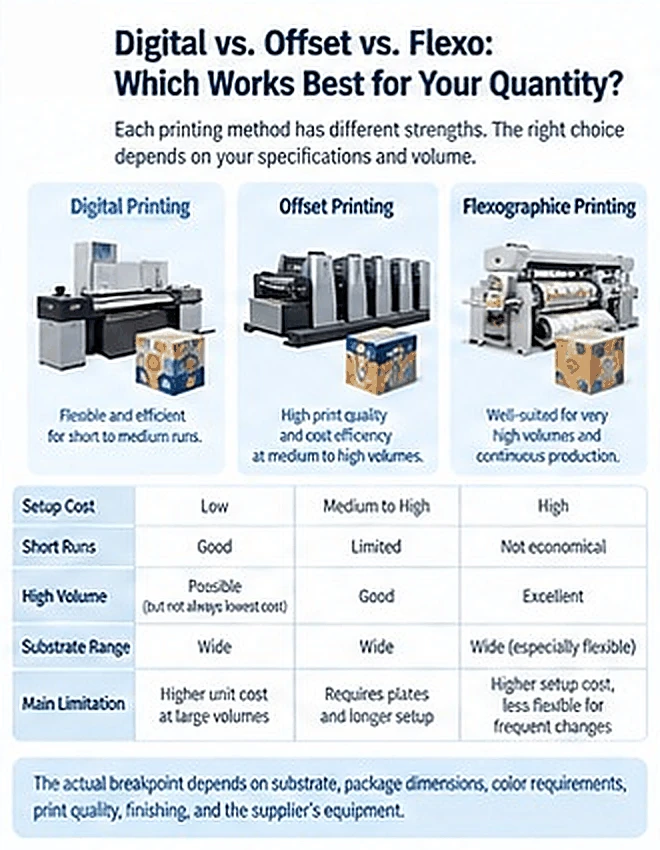
Printing method can have a major impact on MOQ, but there is no universal volume where one process automatically becomes the best choice.
|
Method |
Best For |
Setup Cost |
Short Runs |
High Volume |
Main Limitation |
|
Digital |
Short runs, multiple versions, frequent artwork changes |
Low |
Strong |
Less economical at some higher volumes |
Material, format, and finishing limits may apply |
|
Offset |
High-quality paperboard and carton printing |
Medium to high |
Less efficient |
Strong |
Plates and make-ready increase setup requirements |
|
Flexo |
Corrugated, labels, and flexible packaging |
Medium to high |
Depends on application |
Strong |
Plates, cylinders, and substrate requirements can raise minimums |
A lower digital printing MOQ can make digital attractive for smaller runs, but printing method should not be selected by quantity alone.
For this reason, buyers comparing digital vs. offset printing should ask the supplier to quote more than one production method when practical. The lowest-MOQ option is not always the lowest-cost option at the quantity you actually need.
Should You Negotiate the MOQ or Change the Packaging Specification?
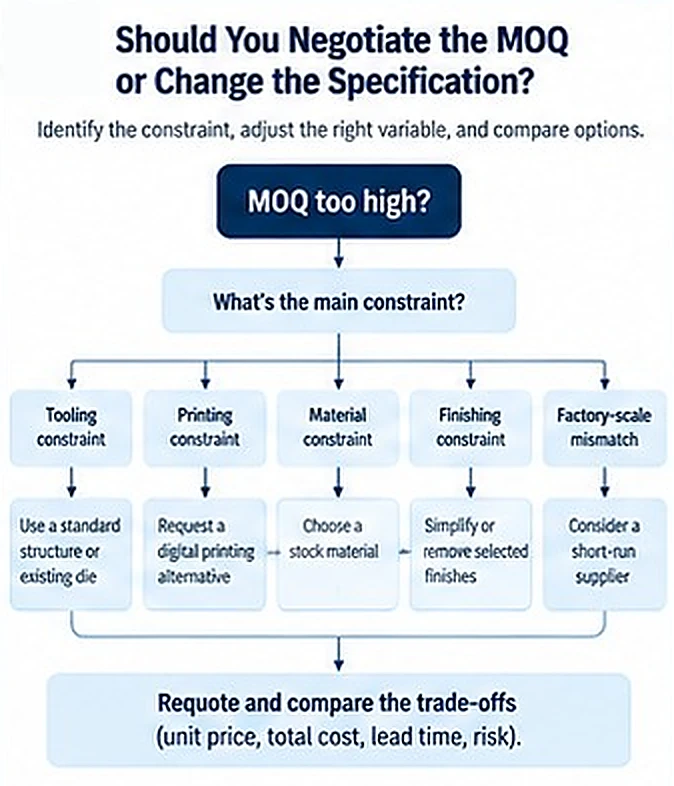
If a packaging MOQ is too high, first identify what is creating the minimum.
The most effective approach is:
Identify the constraint → Change the relevant variable → Requote → Compare the trade-off
|
MOQ Constraint |
Possible Response |
|
New tooling required |
Use a standard structure or existing die |
|
Printing setup is too high |
Request a digital alternative |
|
Specialty material minimum |
Switch to a stock substrate |
|
Complex finishing |
Simplify or remove selected finishes |
|
Supplier is optimized for large runs |
Compare a short-run supplier |
The goal is not simply to ask the supplier to "lower the MOQ." If the minimum comes from a real material, tooling, or machine constraint, negotiation alone may not change it.
Instead, ask what is driving the MOQ and which specification change would have the biggest effect.
If the project still requires the original material, structure, and finishes, then the better solution may be a different production process or a supplier whose equipment is better suited to shorter runs.
Once you know which constraint is driving the MOQ, the next step is to ask the supplier the right questions before accepting the quote.
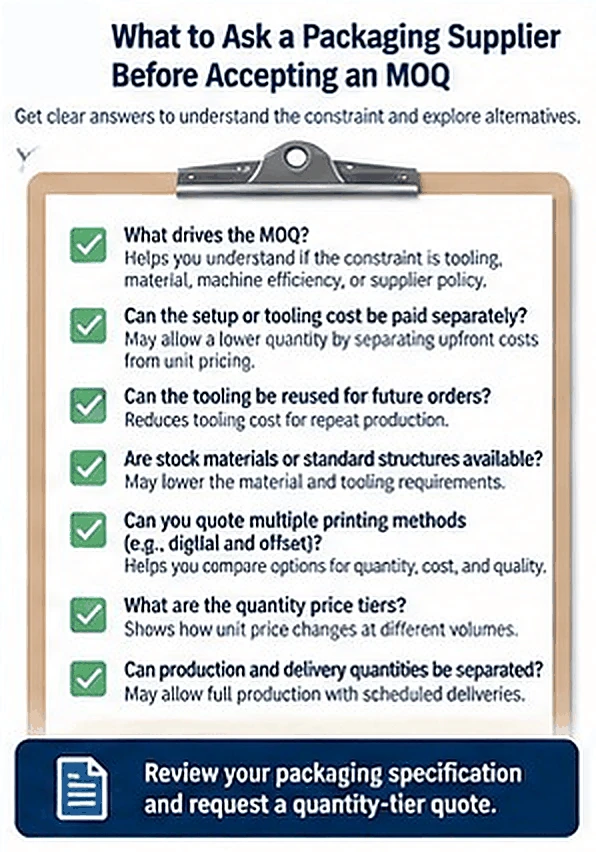
What to Ask a Packaging Supplier Before Accepting an MOQ
Before accepting an MOQ, ask what is driving it and what alternatives are available.
What is the main reason for this MOQ?
This tells you whether the constraint comes from tooling, materials, printing, machine efficiency, or supplier policy.
Can I pay setup or tooling separately for a smaller run?
This helps determine whether the MOQ is mainly tied to recovering upfront costs.
Can existing tooling be reused?
Reusable dies or plates may reduce cost and make future runs more flexible.
Is there a stock material or standard structure alternative?
This shows whether changing the specification could lower the minimum.
Can you quote both digital and conventional printing?
Comparing methods can reveal whether a different process better fits your volume.
What are the prices at several quantity levels?
Tiered pricing shows where unit-cost savings begin to flatten.
Can production and delivery quantities be separated?
A supplier may produce the full MOQ but release inventory in smaller batches.
A useful next step is to request a quantity-tier quote rather than a single MOQ price.
Example: Choosing Between 1,000 and 5,000 Custom Boxes
Consider a buyer comparing two options for the same custom box:
|
Factor |
1,000 Boxes |
5,000 Boxes |
|
Unit Price |
$1.40 |
$0.90 |
|
Total Purchase Cost |
$1,400 |
$4,500 |
|
Upfront Cash Required |
Lower |
Higher |
|
Inventory Exposure |
Lower |
Higher |
|
Storage Requirement |
Lower |
Higher |
|
Obsolescence Risk |
Lower |
Higher |
For a mature SKU with stable demand, 5,000 units may make sense because the inventory is likely to be used and the lower unit price creates meaningful savings.
For a new product launch, 1,000 units may be the better decision even at a higher unit price. The buyer gives up some unit-cost savings in exchange for lower cash exposure and less risk of unused packaging.
The key point is that the same supplier pricing can lead to different decisions depending on demand certainty, storage capacity, and product lifecycle.
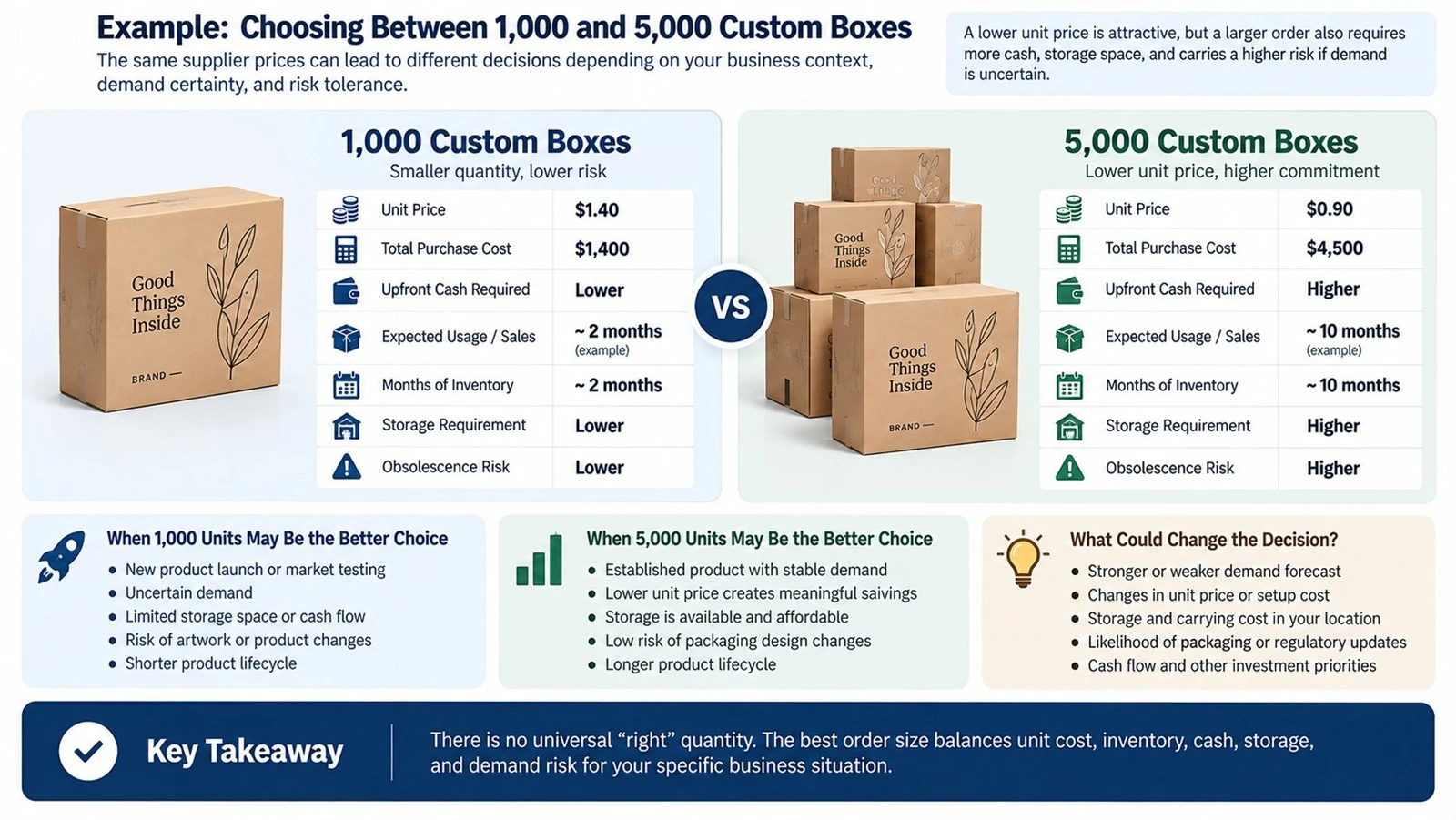
What Would Change the Decision?
The larger order becomes more attractive when demand is predictable, storage is inexpensive, and the packaging design is unlikely to change.
The smaller order becomes more attractive when demand is uncertain, cash is constrained, or the packaging may soon require artwork or product updates.
Packaging MOQ FAQ
Is MOQ usually per SKU or per total order?
It depends on the production process. Some suppliers apply MOQ per design or SKU because each version requires separate setup. Others may combine versions if the structure, material, and production method are compatible.
Can multiple artwork versions be combined into one production run?
Sometimes. Gang printing or versioned production may allow several designs to share part of the same run, but this depends on the supplier's equipment and workflow.
Can I pay more per unit to get a lower MOQ?
In some cases, yes. A supplier may accept a smaller quantity if setup or tooling costs are paid separately. However, material or machine minimums may still apply.
Does digital printing always mean a lower MOQ?
No. Digital often reduces setup requirements, but material, size, finishing, equipment, and quality requirements can still affect the minimum.
Can a supplier produce the full MOQ but ship it in smaller batches?
Yes, some suppliers offer scheduled releases or blanket-order arrangements. Confirm storage fees, payment terms, inventory ownership, and liability before agreeing.
Why do different suppliers quote different MOQs for the same box?
Suppliers may use different equipment, material sources, tooling systems, production schedules, and commercial policies. Their most economical production quantity can therefore differ.
The Bottom Line: Optimize Total Cost, Not Just MOQ
MOQ usually reflects real production economics, but it should not be treated as the ideal order quantity automatically.
A lower unit price may come with higher inventory, cash, storage, and demand risk. The best quantity is the one that balances production cost with the realities of your business.
Instead of comparing MOQ alone, ask suppliers for several quantity options and evaluate the total trade-off.
Compare quantity options, review your packaging specification, and request tiered pricing before committing to a larger run.