
What Are the Chemical Requirements Under the EU PPWR?
The EU Packaging and Packaging Waste Regulation (PPWR) introduces stricter requirements for chemical substances in packaging. These rules aim to reduce hazardous substances, improve packaging safety, and support a more sustainable circular economy.

1.1 What Is the Packaging and Packaging Waste Regulation (EU) 2025/40?
The PPWR (EU 2025/40) is an EU regulation designed to reduce packaging waste and improve packaging sustainability across the European market.
It establishes requirements for packaging design, material composition, recyclability, and chemical safety. Unlike the previous Packaging and Packaging Waste Directive, the PPWR is directly applicable across EU Member States.
1.2 What Does Article 5 Require for Packaging Materials?
Article 5 sets out key requirements for substances of concern in packaging, including:
Substances of concern: Their presence in packaging should be minimised, particularly where they may affect human health or recycling.
Heavy metals: The combined concentration of lead, cadmium, mercury, and hexavalent chromium must not exceed 100 mg/kg.
PFAS: Specific concentration limits apply to PFAS in food-contact packaging.
1.3 Which Packaging Components Are Covered?
Chemical compliance considerations extend beyond the main packaging material. Relevant components may include:
Packaging substrates: Paper, cardboard, and plastic materials.
Printing inks: Pigments, additives, and other chemical ingredients.
Adhesives: Bonding agents used in packaging structures.
Coatings and varnishes: Surface treatments that provide protection or functional properties.
Labels and closures: Additional components that form part of the packaging.
PPWR Article 5 Requirements at a Glance
| Requirement | Scope | Key Consideration |
|---|---|---|
| Substances of concern minimisation | Packaging and its components | Chemical risk assessment and supporting documentation |
| Heavy metals | All packaging | Combined limit of 100 mg/kg for four restricted heavy metals |
| PFAS | Food-contact packaging | Three specific PFAS concentration limits |
PPWR vs. REACH: Understanding the Chemical Compliance Differences
Both PPWR and REACH regulate chemical substances that may affect packaging safety, but they have different scopes and compliance requirements. Understanding how these regulations work together is essential for packaging manufacturers, importers, and brand owners.
2.1 What Does REACH Regulate in Packaging Materials?
The REACH Regulation (EC) No 1907/2006 controls the use and communication of chemical substances in the EU market. Key requirements relevant to packaging include:
SVHC Candidate List: Identifies Substances of Very High Concern that may trigger communication obligations.
REACH Annex XVII: Restricts the use of specific hazardous substances in products and materials.
Article 33 Communication: Requires suppliers to communicate information when an article contains an SVHC above 0.1% by weight.
SCIP Notification: Requires relevant EU suppliers to submit information on articles containing SVHCs above 0.1% to the SCIP database.
2.2 What Are the Differences Between REACH and PPWR?
Although both regulations address chemical safety, they differ in their regulatory focus, substance restrictions, and documentation requirements.
| Comparison | REACH | PPWR |
|---|---|---|
| Main focus | Chemical substance management | Packaging and packaging waste |
| Scope | Substances, mixtures, and articles | Packaging and packaging components |
| Chemical requirements | SVHC communication and substance restrictions | Substances of concern, heavy metals, and PFAS requirements |
| Thresholds | Depend on specific REACH provisions | Includes specific limits under Article 5 |
| Documentation | SDS, SVHC communication, SCIP information where applicable | Technical documentation and Declaration of Conformity |
2.3 Do Packaging Manufacturers Need to Comply With Both Regulations?
Yes. Packaging manufacturers may need to meet both REACH and PPWR requirements because the regulations address different aspects of chemical and packaging compliance.
Manufacturers: Should assess material composition and applicable chemical restrictions.
Importers: Need to verify that imported packaging meets relevant EU requirements.
Brand owners: Should ensure their packaging suppliers provide sufficient compliance information.
Supplier declarations, material specifications, and laboratory test reports can help downstream businesses verify compliance and maintain supporting documentation.
Internal Link Suggestion: Learn more about [REACH Compliance for Packaging Materials] to understand SVHC restrictions, SCIP obligations, and supplier documentation requirements.
PFAS and Heavy Metals: Chemical Substances to Check in Packaging
PFAS and heavy metals are two major chemical compliance concerns under the EU PPWR. Packaging manufacturers should understand the applicable limits and identify potential sources of these substances across different packaging components.
3.1 PFAS Restrictions for Food-Contact Packaging
PFAS (Per- and Polyfluoroalkyl Substances) are a large group of synthetic chemicals commonly used for their water-, oil-, and grease-resistant properties.
Under Article 5 of the PPWR, food-contact packaging must meet the following PFAS limits:
25 ppb: Any individual PFAS, excluding polymeric PFAS.
250 ppb: The sum of PFAS measured through targeted analysis.
50 mg/kg: Total fluorine concentration.
These requirements make it important to assess both intentionally added PFAS and potential contamination from raw materials or manufacturing processes.
3.2 Heavy Metal Limits Under PPWR
Article 5 of the PPWR restricts the combined concentration of four heavy metals in packaging:
Lead (Pb)
Cadmium (Cd)
Mercury (Hg)
Hexavalent Chromium (Cr VI)
The combined concentration of these four metals must not exceed 100 mg/kg (100 ppm) in packaging or packaging components.
Testing should consider the entire packaging structure, including inks, coatings, adhesives, and other components, rather than focusing only on the main substrate.
3.3 Where Can PFAS and Heavy Metals Be Found in Packaging?
Potential sources of chemical substances include:
Functional coatings: Water-, oil-, and grease-resistant treatments.
Printing inks: Pigments and chemical additives.
Adhesives: Bonding agents used in laminated packaging.
Pigments: Colorants that may contain restricted metals.
Surface treatments: Chemical finishes applied to packaging materials.
Recycled material streams: Potential sources of residual chemical contamination.
Identifying these sources helps manufacturers determine where additional supplier verification or laboratory testing may be necessary.

3.4 Other Substances of Concern Under REACH
Beyond PFAS and heavy metals, packaging manufacturers should also consider other restricted substances under REACH, including:
SVHCs: Substances of Very High Concern listed on the Candidate List.
Phthalates: Chemical plasticisers used in certain plastic materials.
PAHs: Polycyclic aromatic hydrocarbons found in some materials and chemical formulations.
Other restricted substances: Chemicals subject to specific restrictions under REACH Annex XVII.
The applicable requirements depend on the substance, material, concentration, and intended use of the packaging.
Chemical Substances, Packaging Components and Regulations
| Chemical Substance | Potential Packaging Components | Relevant Regulation |
|---|---|---|
| PFAS | Coatings, paper, inks | PPWR Article 5 |
| Heavy metals | Pigments, inks, coatings | PPWR Article 5 |
| SVHCs | Plastics, adhesives, inks | REACH |
| Phthalates | Plastic materials, coatings | REACH |
| PAHs | Plastics, rubber components | REACH |
Recommended Visual: Include a packaging structure diagram highlighting the substrate, printing inks, adhesives, coatings, labels, and closures to show where chemical compliance risks may arise.
Chemical Compliance Risks Across Different Packaging Materials
Chemical compliance risks vary depending on packaging materials, manufacturing processes, and intended applications. Manufacturers should evaluate not only the main substrate but also inks, adhesives, coatings, and other components that may contain substances of concern.
4.1 Paper and Paperboard Packaging
Paper and paperboard packaging may involve chemical risks from raw materials, recycled fibers, surface treatments, and printing processes.
Key areas to assess include:
Virgin and recycled fibers: Check material composition and potential chemical contamination.
Grease- and water-resistant coatings: Assess whether PFAS or other restricted substances are present.
Printing inks: Review pigments, additives, and heavy metal content.
Food-contact paper packaging: Evaluate applicable chemical safety requirements.
PFAS alternatives: Consider suitable coating solutions with lower chemical compliance risks.
4.2 Plastic Packaging Materials
Common plastic packaging materials include PET, PE, and PP. Their chemical compliance depends on the polymer formulation, additives, and manufacturing processes.
Important considerations include:
Resins and additives: Review chemical composition and applicable REACH restrictions.
Surface printing: Assess inks and printing-related substances.
Coatings and functional treatments: Check for PFAS and other substances of concern.
Recycled plastics: Request relevant material specifications, supplier declarations, and supporting test reports.
4.3 Printed Packaging and Label Materials
Printing processes can introduce additional chemical substances into packaging materials.
Common printing technologies include:
Flexographic printing: Commonly used for flexible packaging and labels.
Offset printing: Widely used for folding cartons and paperboard packaging.
Gravure printing: Often used for high-volume flexible packaging.
UV and LED-UV inks: Require attention to photoinitiators and potential migration.
Photoinitiators: Certain substances may require additional assessment, particularly in food-contact applications.
Manufacturers should consider both chemical composition and the potential impact of printing systems on packaging safety and recyclability.
4.4 Adhesives, Coatings and Laminated Structures
Adhesives and coatings play important roles in packaging performance but may introduce additional chemical compliance considerations.
Key areas include:
Adhesives: Assess chemical composition and relevant restricted substances.
Barrier coatings: Review functional additives and potential PFAS content.
Laminated materials: Evaluate the different layers and their chemical properties.
Multilayer packaging: Consider the combined structure rather than assessing only individual materials.
Compliance documentation: Ensure supporting evidence covers the relevant components and suppliers.
4.5 Food-Contact vs. Non-Food-Contact Packaging
Chemical requirements may differ depending on whether packaging is intended for direct or indirect food contact.
Food-contact packaging: Requires particular attention to PFAS restrictions under PPWR Article 5 and other applicable food-contact legislation.
Non-food-contact packaging: Remains subject to relevant PPWR requirements, including applicable restrictions on heavy metals and substances of concern.
Intended use: Manufacturers should consider the packaging's function, contact conditions, and applicable regulatory definitions.
Food-contact compliance should not be assumed solely from general PPWR compliance. Other relevant EU food-contact requirements may also apply.
Packaging Material Chemical Risk Matrix
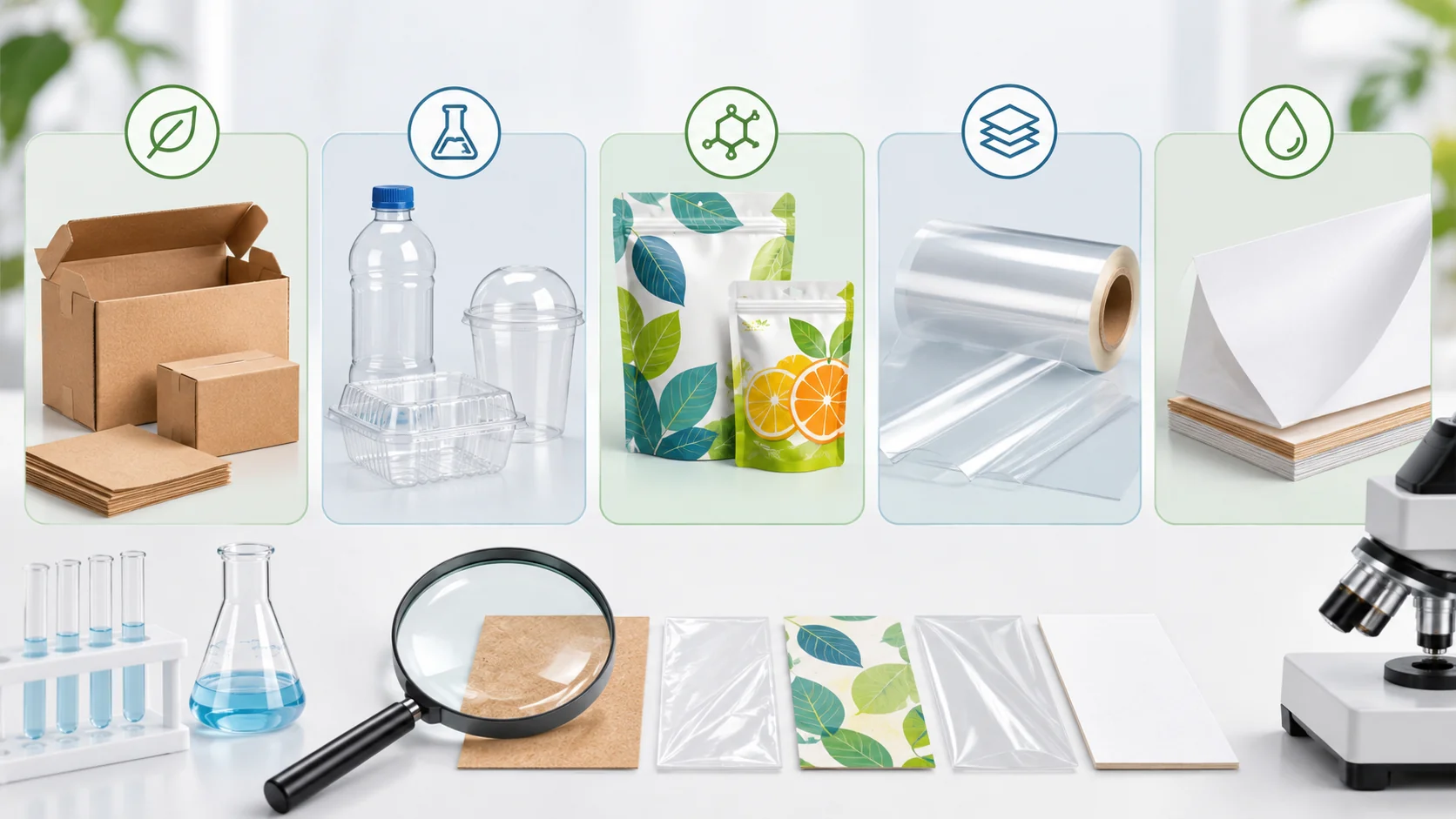
| Packaging Material | Potential Chemical Risks | Key Compliance Checks |
|---|---|---|
| Paper and paperboard | PFAS, heavy metals, SVHCs | Fiber composition, coatings, inks |
| Plastic packaging | Additives, SVHCs, heavy metals | Resin composition, additives, recycled content |
| Printed packaging | Photoinitiators, heavy metals, PFAS | Ink formulations and migration assessment |
| Adhesives | SVHCs and other restricted substances | Chemical composition and supplier declarations |
| Coatings and laminates | PFAS and other substances of concern | Coating formulations and component-level assessment |
Example: Chemical Risk Assessment of a Multilayer Food Packaging Bag
A multilayer food packaging bag may contain several components, each requiring separate consideration:
Base substrate: Assess the plastic film composition and additives.
Printing layer: Review ink formulations, pigments, and potential chemical migration.
Adhesive layer: Check bonding agents and relevant restricted substances.
Functional coating: Evaluate PFAS content and applicable food-contact requirements.
A component-level assessment helps manufacturers identify potential chemical risks and collect appropriate compliance evidence across the entire packaging structure.
How to Test Packaging Materials for PFAS and Heavy Metals
Chemical testing helps packaging manufacturers identify restricted substances and verify compliance with the EU PPWR. Testing methods should be selected based on material composition, intended use, and chemical risk levels.
5.1 How to Test PFAS in Food Packaging

PFAS testing typically involves several methods:
Total fluorine screening: Measures overall fluorine content to identify potential concerns.
Organic fluorine analysis: Helps distinguish organic fluorine from inorganic sources.
Targeted PFAS analysis: Measures specific PFAS compounds against regulatory limits.
TOP assay: Helps detect PFAS precursors through chemical oxidation.
Under PPWR Article 5, food-contact packaging must meet PFAS limits of 25 ppb for individual PFAS, 250 ppb for the sum of targeted PFAS, and 50 ppm for total PFAS, subject to the regulation's measurement rules.
Total fluorine results alone do not establish PFAS concentrations. Further analysis or supporting evidence may be needed.
5.2 How to Test Heavy Metals in Packaging
PPWR restricts four heavy metals: lead, cadmium, mercury, and hexavalent chromium. Their combined concentration must not exceed 100 mg/kg in packaging or packaging components.
Laboratories may use ICP-MS, ICP-OES, or other suitable methods. Hexavalent chromium requires an appropriate method that distinguishes it from other chromium forms.
Testing should consider relevant components, including substrates, inks, coatings, and adhesives. Laboratory reports should clearly identify the tested materials and results.
5.3 When Do You Need a Laboratory Test?
Testing needs depend on material risks and available compliance evidence.
Low risk: Reliable supplier declarations and material specifications may support compliance assessment.
Medium risk: Additional documentation or targeted testing may be appropriate.
High risk: Laboratory testing is generally recommended to verify chemical concentrations.
Supplier declarations should be verified for relevance and reliability. Changes in material formulations, suppliers, or manufacturing processes may require reassessment or retesting.
5.4 How to Choose a Packaging Chemical Testing Laboratory
When selecting a laboratory, consider:
Testing methods: Suitable for the relevant chemicals and packaging materials.
Technical capabilities: Experience with PFAS and heavy metal analysis.
Accreditation: ISO/IEC 17025 accreditation covering the relevant testing scope.
Report quality: Clear sample identification, methods, units, dates, and results.
Limitations: Understanding which substances and components the report covers.
PFAS Testing Decision Process
Identify packaging materials and potential PFAS sources.
Review supplier declarations and chemical information.
Conduct fluorine screening where appropriate.
Perform targeted PFAS analysis or additional testing when needed.
Compare results against applicable PPWR limits and retain supporting evidence.
Heavy Metals Testing Checklist
| Check Item | Requirement |
|---|---|
| Restricted metals | Pb, Cd, Hg, Cr(VI) |
| Concentration limit | Combined total ≤ 100 mg/kg |
| Testing scope | Packaging and relevant components |
| Test methods | Suitable validated analytical methods |
| Documentation | Laboratory reports and supplier evidence |
Important: Laboratory testing is not automatically mandatory for every packaging material or batch. Compliance verification should follow applicable legal requirements, relevant regulatory guidance, and a risk-based assessment approach.
What Documents Should Packaging Suppliers Provide for PPWR Compliance?
Proper documentation helps packaging manufacturers and buyers verify chemical compliance under PPWR and REACH. Suppliers should provide relevant declarations, material specifications, and supporting test reports where applicable.
6.1 REACH Compliance Declaration
A REACH compliance declaration helps confirm whether packaging materials meet applicable chemical restrictions. It should include:
SVHC information: Disclosure of substances above the applicable 0.1% threshold.
Annex XVII compliance: Confirmation of relevant substance restrictions.
Material identification: Clear descriptions of packaging materials and components.
Document details: Supplier name, issue date, and declaration version.
6.2 PFAS and Heavy Metal Test Reports
Laboratory reports provide supporting evidence of chemical concentrations. Key information includes:
Test samples: Materials or packaging components tested.
Testing units: Results reported in ppb, ppm, or mg/kg.
Test methods: Analytical techniques used.
Testing date: When the analysis was performed.
Results: Measured concentrations compared with applicable limits.
6.3 Safety Data Sheets and Material Specifications
Safety Data Sheets (SDS) provide information about chemical hazards and safe handling, while material specifications describe packaging composition and performance.
Suppliers should provide relevant composition information and declarations where necessary.
However, an SDS alone does not prove full PPWR or REACH compliance, as it may not cover all restricted substances or finished packaging components.
6.4 Declaration of Conformity and Technical Documentation
The EU Declaration of Conformity (DoC) confirms that the manufacturer takes responsibility for the packaging's compliance with applicable PPWR requirements.
Annex VII: Establishes the conformity assessment procedure and technical documentation requirements.
Annex VIII: Specifies the structure of the EU Declaration of Conformity.
Component traceability: Supporting records should connect packaging materials and components to the relevant packaging type.
PPWR documentation should also be distinguished from declarations required under other applicable EU regulations.
6.5 How to Verify a Supplier's Compliance Documents
Before accepting supplier documentation, packaging buyers should check:
Supplier identity: Confirm the document comes from the relevant supplier.
Material accuracy: Ensure it matches the actual packaging material or component.
Document validity: Check issue dates, revisions, and current applicability.
Component coverage: Verify whether printing inks, coatings, and adhesives are included.
Change management: Request updated evidence when material formulations or suppliers change.
Supplier Compliance Document Checklist

| Document | Key Information to Verify |
|---|---|
| REACH Declaration | SVHC status and applicable restrictions |
| PFAS Test Report | Tested substances, results, and applicable limits |
| Heavy Metal Test Report | Pb, Cd, Hg, and Cr(VI) concentrations |
| SDS | Chemical hazard and safety information, where applicable |
| Material Specification | Material composition and identification |
| PPWR DoC | Applicable requirements and manufacturer declaration |
| Technical Documentation | Component records and supporting compliance evidence |
Recommended Resource: Packaging Supplier Chemical Compliance Request Template - a downloadable checklist to help buyers request and review supplier documentation efficiently.
How to Build a PPWR-Compliant Packaging Material Selection Process

Selecting compliant packaging materials requires evaluating chemical risks, supplier documentation, and product performance. A structured selection process helps manufacturers reduce compliance risks before purchasing.
7.1 Identify All Materials and Packaging Components
Start by creating a complete list of packaging components, including substrates, inks, coatings, adhesives, and labels.
Identify whether the packaging is intended for direct or indirect food contact, and record each material's supplier and origin.
7.2 Assess Chemical Risks Before Purchasing
Evaluate materials based on applicable PPWR and REACH requirements.
Regulatory scope: Identify relevant chemical restrictions.
Chemical risks: Check potential PFAS, heavy metals, and SVHCs.
Risk classification: Categorise materials as low, medium, or high risk.
Documentation gaps: Identify missing declarations or test reports.
7.3 Compare Alternative Packaging Materials
Compare paper and plastic packaging, different coating technologies, and printing ink systems.
Consider chemical composition, barrier performance, recyclability, and intended use. No material is automatically PPWR-compliant; compliance depends on its formulation, packaging structure, application, and supporting evidence.
7.4 Establish Ongoing Supplier Monitoring
Packaging compliance requires continuous monitoring. Manufacturers should:
Request updated supplier declarations when necessary.
Monitor changes to the REACH SVHC Candidate List.
Require notifications of material or formulation changes.
Maintain testing records and compliance assessments.
Packaging Material Selection Process
Identify materials and components.
Review applicable chemical restrictions.
Assess chemical risks and supplier evidence.
Compare suitable material alternatives.
Verify compliance before approval.
Supplier Evaluation Scorecard
| Evaluation Criteria | Key Assessment |
|---|---|
| Chemical compliance | Applicable PPWR and REACH requirements |
| Documentation | Declarations and supporting test reports |
| Material performance | Suitability for intended packaging use |
| Traceability | Material origin and supplier identification |
| Change management | Updates on formulations and compliance status |
Common Mistakes in Packaging Chemical Compliance
Packaging compliance mistakes can lead to incomplete assessments and unreliable documentation. Avoiding these common issues helps manufacturers improve chemical risk management.
8.1 Testing Only the Main Packaging Substrate
Focusing only on paper or plastic substrates may overlook restricted substances in inks, coatings, adhesives, and other components.
8.2 Confusing REACH SVHC Requirements With PPWR Limits
REACH SVHC communication thresholds and PPWR chemical concentration limits serve different purposes. Both should be assessed independently where applicable.
8.3 Treating Supplier Declarations as Permanent Certificates
Supplier declarations may become outdated when chemical regulations, material formulations, or manufacturing processes change.
8.4 Ignoring Printing Inks, Coatings and Adhesives
These components may contain substances of concern and should be included in chemical risk assessments.
8.5 Using the Wrong PFAS Testing Approach
Total fluorine screening alone cannot determine the concentrations of individual PFAS. Appropriate analytical methods and supporting evidence are essential.
8.6 Failing to Update Material Records After Supplier Changes
Supplier or formulation changes can affect chemical compliance. Documentation should be reviewed whenever relevant changes occur.
Common Mistakes vs. Correct Approaches
| Common Mistake | Correct Approach |
|---|---|
| Testing only substrates | Assess relevant packaging components |
| Confusing REACH and PPWR | Review each regulation separately |
| Using outdated declarations | Verify and update supplier records |
| Ignoring inks and coatings | Include all relevant material layers |
| Relying only on fluorine screening | Use appropriate PFAS verification |
| Overlooking supplier changes | Reassess materials after changes |
How to Prepare Your Packaging Supply Chain for PPWR Compliance
Preparing for PPWR compliance requires coordinated material assessments, supplier verification, and ongoing documentation management.
9.1 Review Your Current Packaging Portfolio
Identify all packaging materials, components, suppliers, and intended applications. Prioritise products intended for the EU market.
9.2 Request Updated Supplier Documentation
Collect relevant REACH declarations, material specifications, PFAS information, heavy metal test reports, and other supporting compliance documents.
9.3 Prioritise High-Risk Packaging Components
Focus on materials with greater chemical uncertainty, such as functional coatings, printing inks, adhesives, and certain recycled materials.
9.4 Complete Necessary Testing and Verification
Use risk-based assessments to determine whether additional laboratory testing or supplier verification is needed.
9.5 Maintain Traceable Compliance Records
Keep material specifications, supplier declarations, test reports, and assessment records linked to the relevant packaging products and components.
PPWR Compliance Action Checklist
Review packaging materials and components.
Collect updated supplier documentation.
Identify high-risk substances and materials.
Complete necessary testing and verification.
Maintain traceable compliance records.
Need Help With Packaging Material Compliance?
Choosing suitable packaging materials and verifying supplier documentation can be challenging. Contact our packaging team to discuss material selection, chemical compliance requirements, and supporting documentation for your packaging applications.
Frequently Asked Questions About PPWR Chemical Requirements
1. Does PPWR apply to all packaging materials?
Yes. PPWR covers packaging placed on the EU market, although specific chemical requirements depend on the packaging type, components, and intended use.
2. What is the difference between REACH and PPWR?
REACH regulates chemical substances across various products and materials, while PPWR establishes packaging-specific requirements, including restrictions on certain chemicals.
3. Are PFAS completely banned in packaging under PPWR?
No. PPWR Article 5 establishes specific PFAS concentration limits for food-contact packaging. Other EU chemical restrictions may also apply.
4. What is the heavy metal limit under PPWR?
The combined concentration of lead, cadmium, mercury, and hexavalent chromium must not exceed 100 mg/kg, subject to applicable regulatory provisions.
5. Do non-food-contact packaging materials require PFAS testing?
PPWR Article 5 does not impose the same PFAS concentration limits on non-food-contact packaging. However, other applicable chemical restrictions and risk assessments may still be relevant.
6. Is a supplier declaration enough to prove PPWR compliance?
Not always. Its adequacy depends on the material, chemical risks, applicable requirements, and supporting evidence. Additional testing or documentation may be necessary.
7. Do packaging manufacturers need to test every component?
Not necessarily. Testing decisions should consider material risks, supplier information, available evidence, and relevant regulatory requirements.
8. Can recycled packaging materials meet PPWR requirements?
Yes. Recycled materials can meet PPWR requirements when their composition, intended use, and supporting compliance evidence demonstrate conformity.
9. When should packaging compliance documents be updated?
Documents should be reviewed when regulations, suppliers, formulations, manufacturing processes, or other relevant compliance conditions change.
10. How can manufacturers choose PPWR-compliant packaging materials?
Manufacturers should evaluate material composition, intended use, chemical restrictions, supplier documentation, and testing evidence before approving packaging materials.