
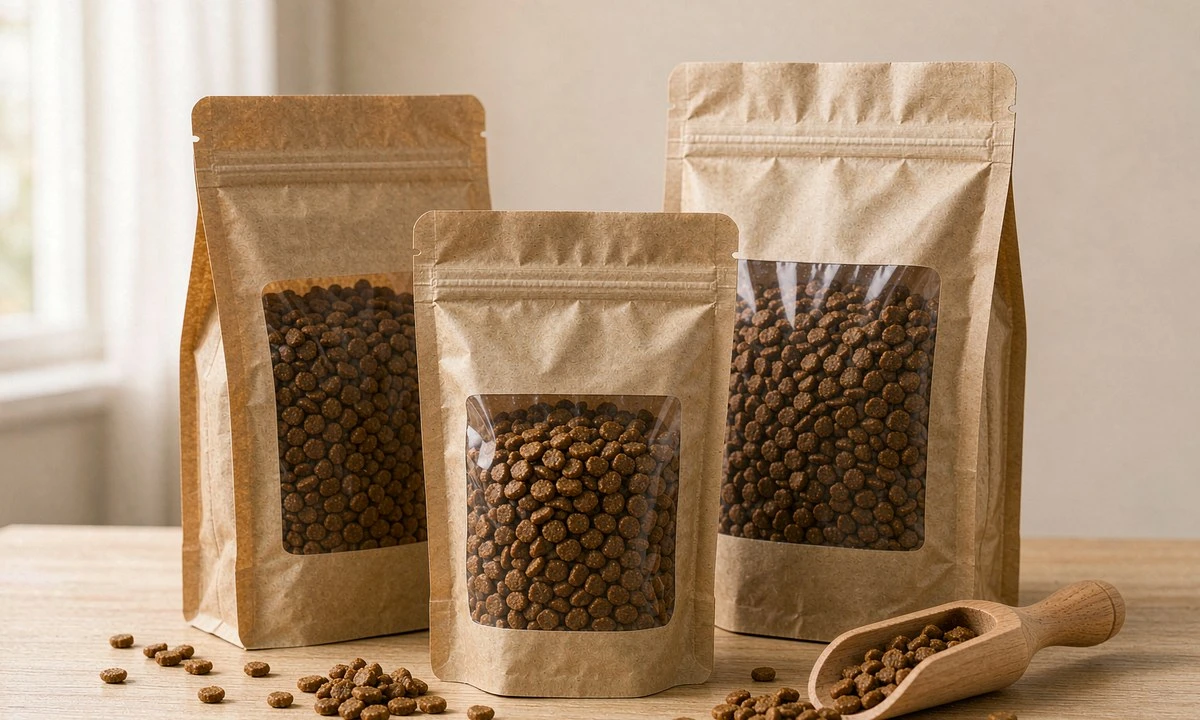
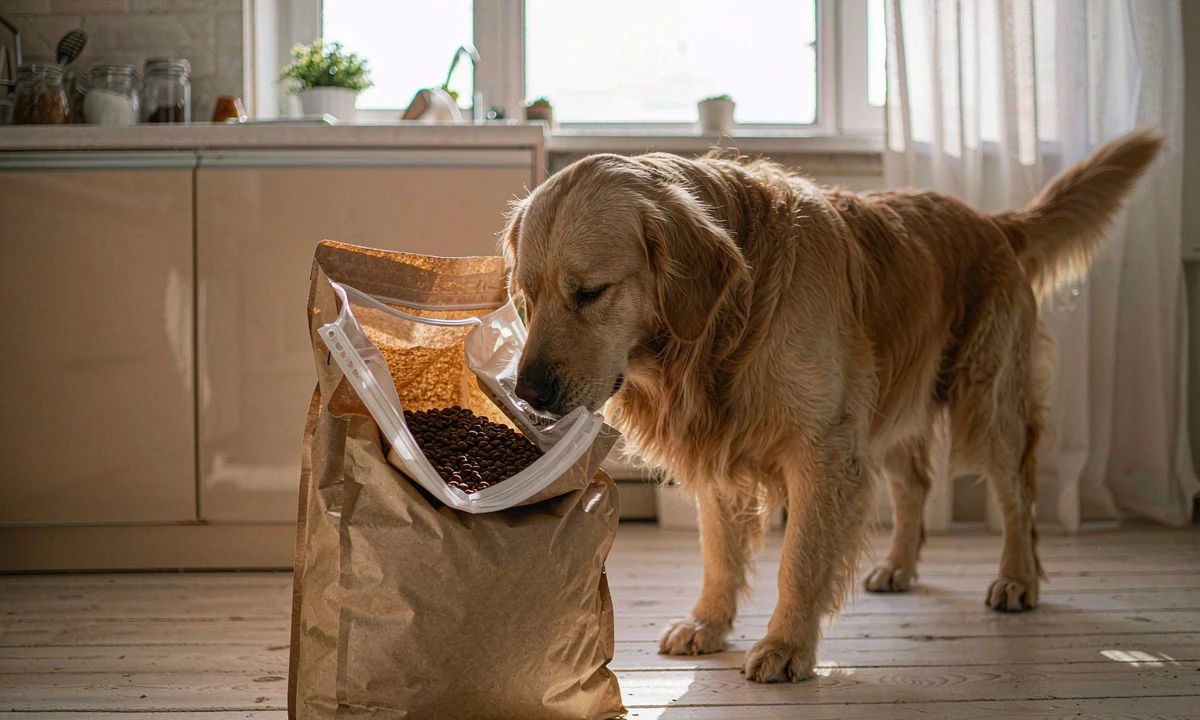
Pet food is one of the few categories where packaging has to survive a bag of hard, oily, abrasive pellets being dropped on a concrete floor, then sit in a kitchen for six weeks while a dog works the zipper open with its nose. Add feed regulations that dictate what must appear on the label, and you have a product where structure, barrier performance and compliance all pull in different directions at once. This guide covers the paper-based routes through that problem: kraft and white paper bags with windows, flat-bottom pouches, treat cartons, paper tubes and canisters, plus the labels that carry the legal text. It is written for brand owners specifying a custom pet food packaging project, and for the converters who have to make the drawings work on a real filling line.
Why Kibble Is Harder on Paper Than Most Products
Most paper packaging briefs are about looks and stacking strength. Pet food adds four physical stresses that paper alone does not handle well, and every specification decision follows from them.
- Grease and oil migration. Extruded kibble carries surface fat. Over weeks that fat wicks into uncoated paper and produces translucent patches that read as a quality defect, even though the food is fine.
- Abrasion. Dry pellets behave like gravel. In a bag that is shaken, dropped or palletised, they scuff the inside of the paper and can wear through a thin coating at the seams.
- Moisture and aroma exchange. Kibble is hygroscopic. Paper alone is a poor moisture barrier, so a paper-forward bag almost always carries a film or foil layer somewhere in the structure.
- Odour containment. Fat oxidation produces the rancid notes that owners notice immediately. Barrier layers and good seals matter as much for smell as for shelf life.
There is also a compliance layer: guaranteed analysis, feeding guidelines, batch and best-before coding, and ingredient statements all need readable space on a surface that is often curved and sometimes gloss-laminated.
The Formats That Cover Most Pet Food Projects
In practice, six structures cover the vast majority of retail and e-commerce pet food. Choosing between them is mostly a question of pack weight, shelf channel and how much print area the brand needs.
| Format | Typical Fill | Best Channel | Notes |
|---|---|---|---|
| Stand-up pouch with window | 0.5 - 3 kg | Pet specialty retail, e-commerce | Self-standing, strong front panel, window shows product |
| Flat-bottom bag | 1 - 5 kg | Premium retail | Box-like silhouette, five printable panels, higher unit cost |
| Side-gusset paper bag | 1 - 10 kg | Wholesale, farm supply, export | Classic sack look, low cost, needs inner liner |
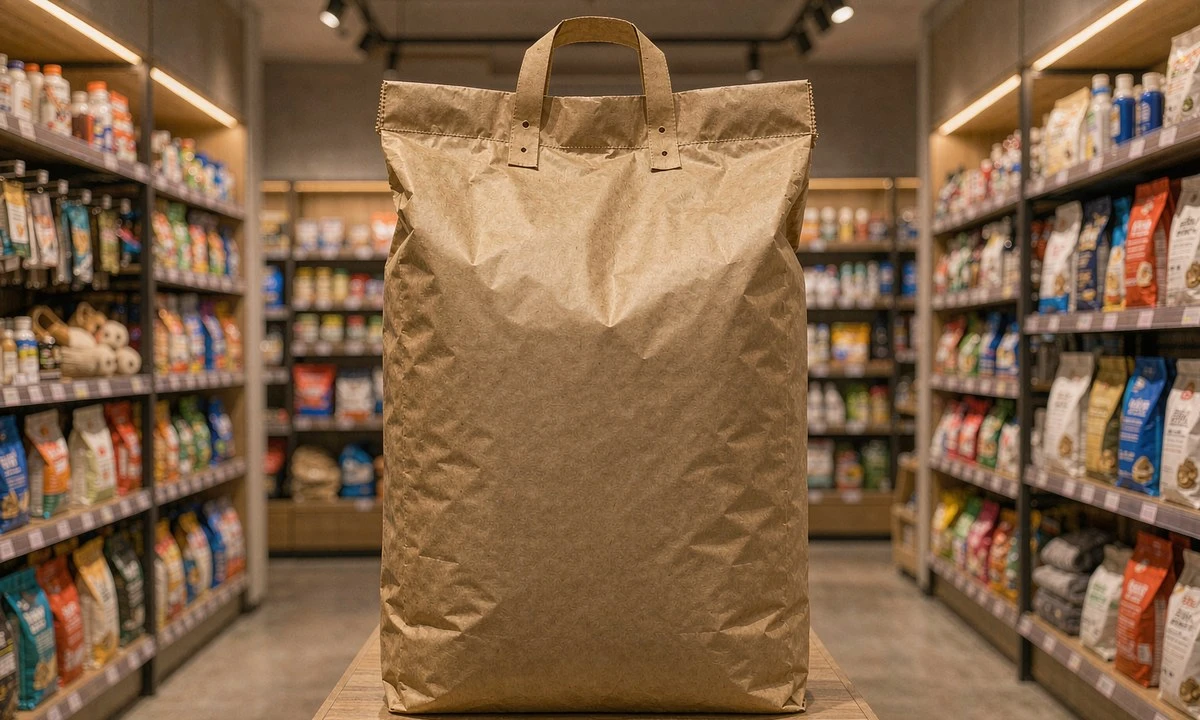
| Paper sack with handle | 5 - 20 kg | Bulk retail, click-and-collect | Reinforced handle and stitched or folded top |
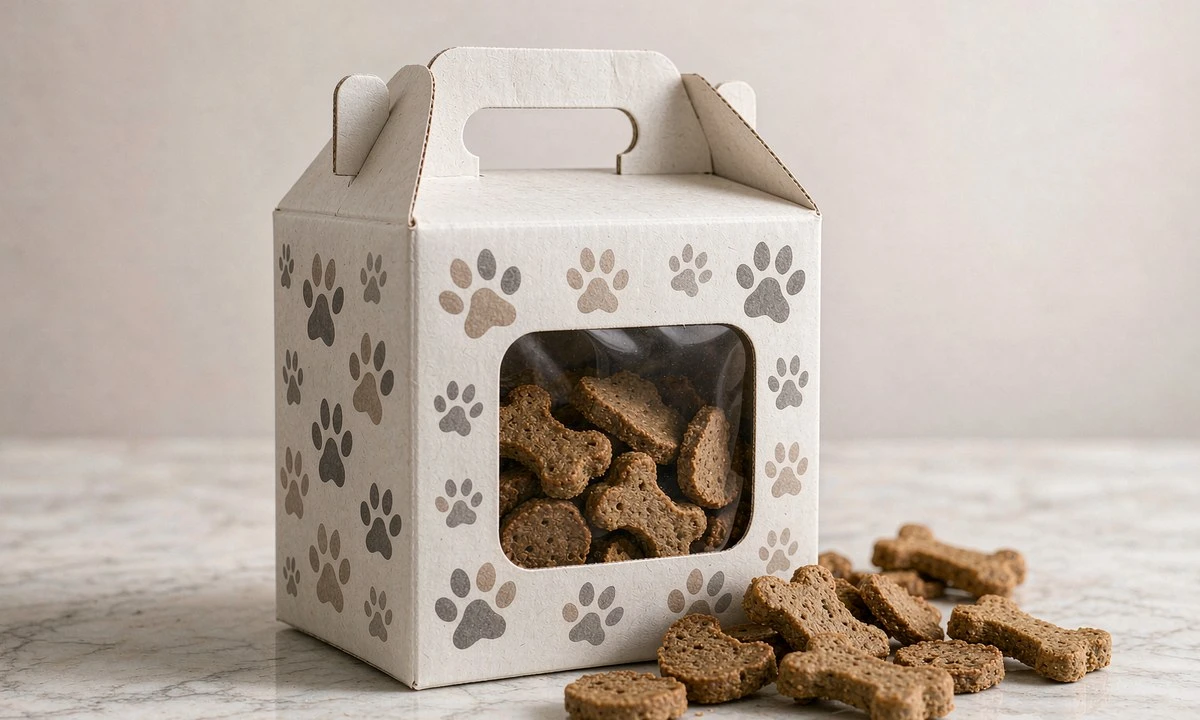
| Treat carton / window box | 50 - 500 g | Impulse shelf, checkout | Rigid shape, die-cut window, excellent print |
| Paper tube / canister | 100 - 500 g | Premium treats, gift | Round shelf presence, airtight option with liner |
Paper Bags With Windows: The Retail Workhorse
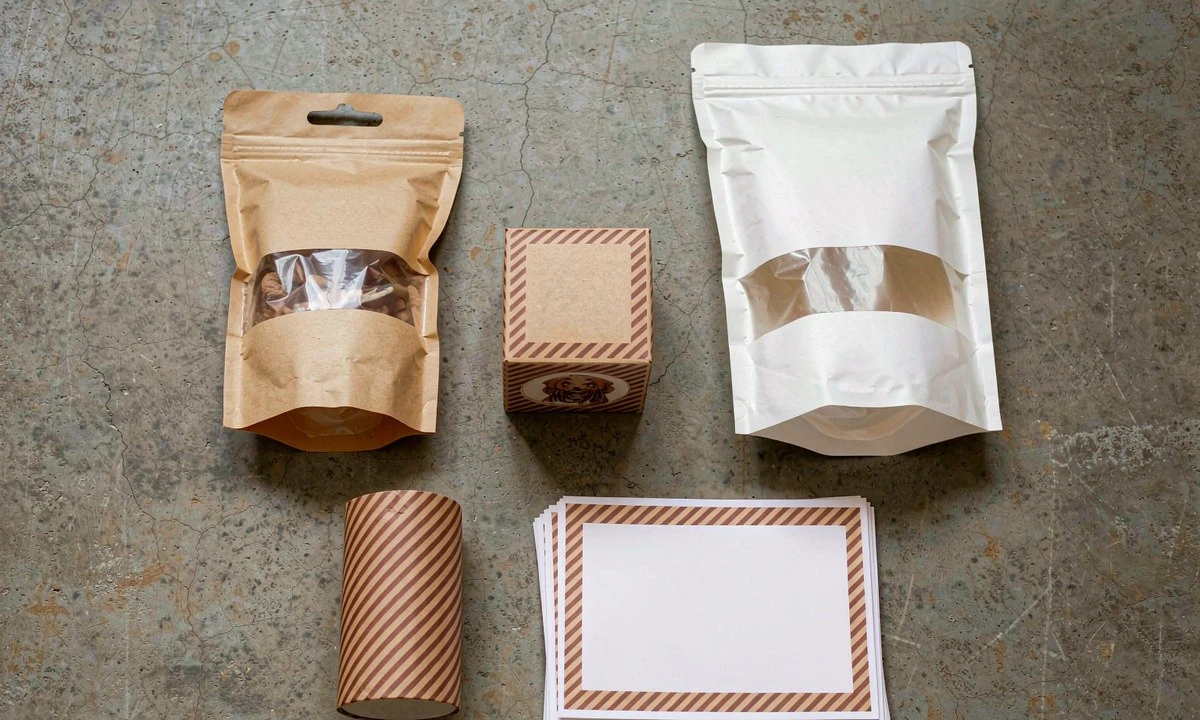
The window bag is the default for dry food under about three kilos because it does two jobs at once: it lets the owner see the kibble size and colour, and it turns the pack into a billboard on a crowded shelf. A well-made version is a laminate, not a sheet of paper - typically bleached or unbleached kraft on the outside, a thin barrier film in the middle, and a heat-seal layer inside.
Window decisions drive most of the cost and most of the complaints:
- Window material. Clear PET is the cheapest and most transparent; PLA film supports a compostability story but is softer and scratches more.
- Window shape. A rectangle with 8 - 10 mm radius corners resists tearing far better than a sharp-cornered cut, which concentrates stress at the corners during palletising.
- Window position. Keep the window at least 15 mm from the bottom fold, where the bag takes the most load, and away from the top seal where the zipper sits.
- Window proportion. Above roughly 40 percent of the front panel, the bag loses stiffness and starts to slump on shelf.
Kraft texture is doing real brand work here, but it is also unforgiving: ink sits differently on unbleached fibre than on coated white board, and colours shift warmer and darker. If the design depends on a specific brown, specify the paper grade first and build the palette around it. Our guide to custom kraft paper bags covers how unbleached kraft behaves through printing, lamination and folding.
Flat-Bottom and Large-Format Bags
Once a pack passes about three kilos, the geometry changes. A flat-bottom bag sits like a box, fills predictably, and can carry a gusseted base that keeps a 5 kg load stable on a pallet. Side-gusset sacks are the cheaper answer for bulk and export: they fold flat for freight, run on standard VFFS equipment, and accept a sewn or folded-and-glued top.
Two details separate a bag that survives distribution from one that leaks in the warehouse:
- Seam construction. On paper sacks, the longitudinal seam should be glued with a lap seam, not a fin seam, and the glue line must stay continuous at the fold.
- Handle attachment. Paper handles need a reinforcement patch or a folded multi-ply strip; a single-ply handle tears at the slot on the first lift of a 10 kg bag.
For e-commerce, the same product often ships in a plain kraft overbox. Whatever the outer structure, set its internal dimensions from the filled bag rather than the flat one: a 5 kg bag bulges several millimetres past its stated height once the kibble settles, and a tight outer box will fight the packing line every shift.
What "Paper" Actually Means in a Pet Food Bag
Almost no commercial pet food bag is pure paper. The word describes the outer surface, and the structure underneath decides whether the food is still fresh in month six. The common builds:
| Structure | Barrier | Typical Use | Trade-off |
|---|---|---|---|
| Kraft / PE | Low - moisture only | Short shelf life, local sales | Cheapest, limited protection against fat |
| Kraft / VMPET / PE | Good - light, oxygen, moisture | Mainstream dry food, 9 - 12 months | Not recyclable in paper streams |
| Kraft / foil / PE | Excellent | Export, long distribution, sensitive formulas | Highest cost, foil creases visible on shelf |
| Coated paper / mono-PE | Moderate | Brands with recyclability targets | Shorter shelf life, stiffness loss |
| Greaseproof liner in paper sack | Fat barrier only | Bulk, short-cycle wholesale | No aroma barrier |
The grease question deserves its own test. Ask for a kit test or a 30-day fat migration trial on the actual kibble, at the actual storage temperature. A coating that passes a generic grease test can still fail on a high-fat puppy formula in a warm warehouse.
Closures, Handles and the Opening Experience
The closure is where owners judge the pack, because it is the part they touch twice a day.
- Press-to-close zipper. The standard for 1 - 5 kg bags. Specify a wide-track zipper and a tear notch that lines up with it, otherwise the first opening tears the panel.
- Slider zipper. Easier for older owners and for large bags, at roughly double the closure cost.
- Tin tie. Cheap and tactile, but a poor moisture seal once opened; better for treats than for daily food.
- Hook-and-loop or fold-over flap. Common on paper sacks; works only if the paper has enough stiffness to hold the fold.
- Degassing. Not usually needed for kibble, but relevant for freeze-dried raw and fermented products, which can build pressure in a sealed pack.
Treat Cartons and Window Boxes
Treats are an impulse purchase, and impulse purchases are decided in about two seconds. That makes the carton the highest-leverage piece of print in the category: a rigid folding carton with a die-cut window shows the product, holds its shape on a shelf hook or counter unit, and gives you six printable faces plus a lid.
Design notes that come up on almost every treat carton project:
- Board weight. 300 - 350 gsm folding boxboard is the practical floor for a carton that will be handled in a store; below that the window area flexes and cracks the print.
- Window film should be laminated between board plies where possible, so the film edge is not exposed to a dog's teeth in the car.
- Locking tabs beat glue for short runs, because they allow flat shipping and local assembly.
- Food-safe inks. Cartons that hold loose treats need low-migration inks and a functional barrier if the print is on the inside face.
If your line includes a counter display or a shelf-ready tray, plan the carton and the display together - the outer dimensions and the print hierarchy have to agree. The structural options are set out in our guide to custom paper packaging boxes.
Paper Tubes and Canisters
Tubes have quietly become the premium signal in pet treats. A wound paper canister with a paper lid reads as giftable, stacks well for e-commerce, and gives a 360-degree print surface that a carton cannot match. The catch is the liner: a bare paper tube transmits moisture and odour, so treat canisters normally use an inner PE or foil-lined ply, or a bag-in-tube construction.
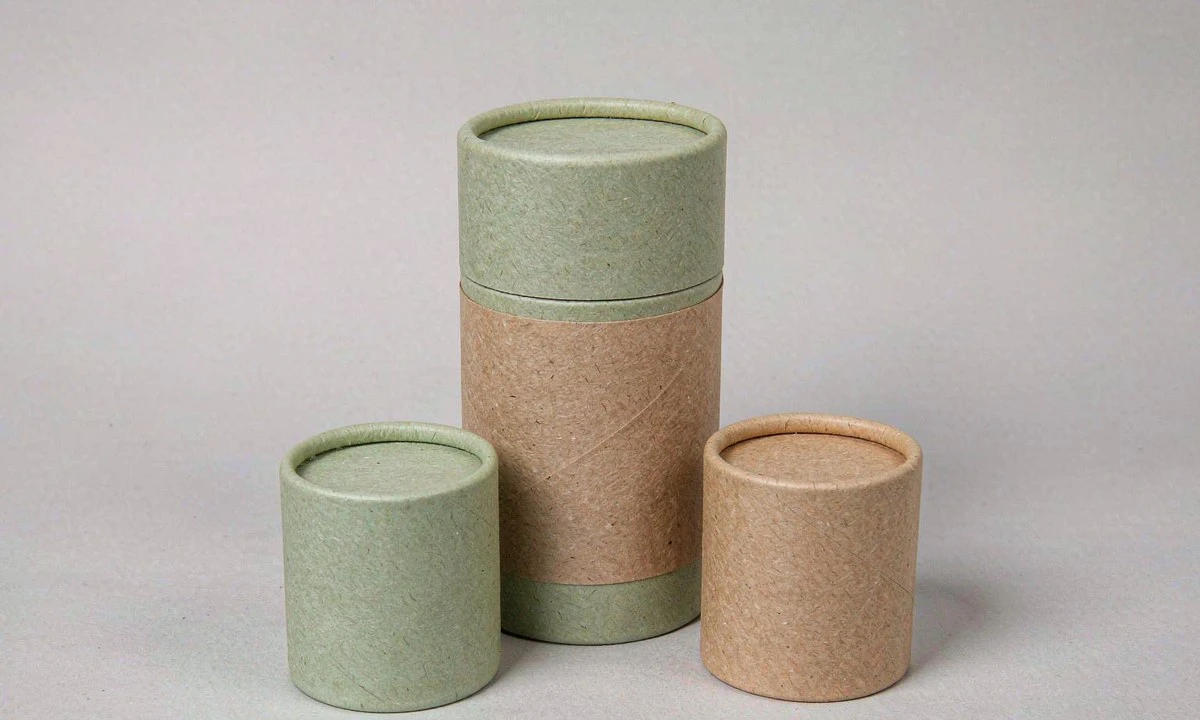
Practical points for tubes: specify the wall thickness in millimetres rather than "standard", confirm the lid fit after conditioning at 50 percent relative humidity, and allow for the seam bulge when designing a wrap-around label. Tubes also ship poorly if the lid is a friction fit only - a paper tear strip or a shrink band prevents the lid lifting in transit.
Labels: The Legal and Brand Surface
Labels do the work that printing cannot flex around. Pet food changes formula, batch and claim far more often than packaging changes design, and every change brings new mandatory text. A blank or lightly printed bag plus a custom label is often the cheapest way to stay compliant while keeping a consistent shelf look.
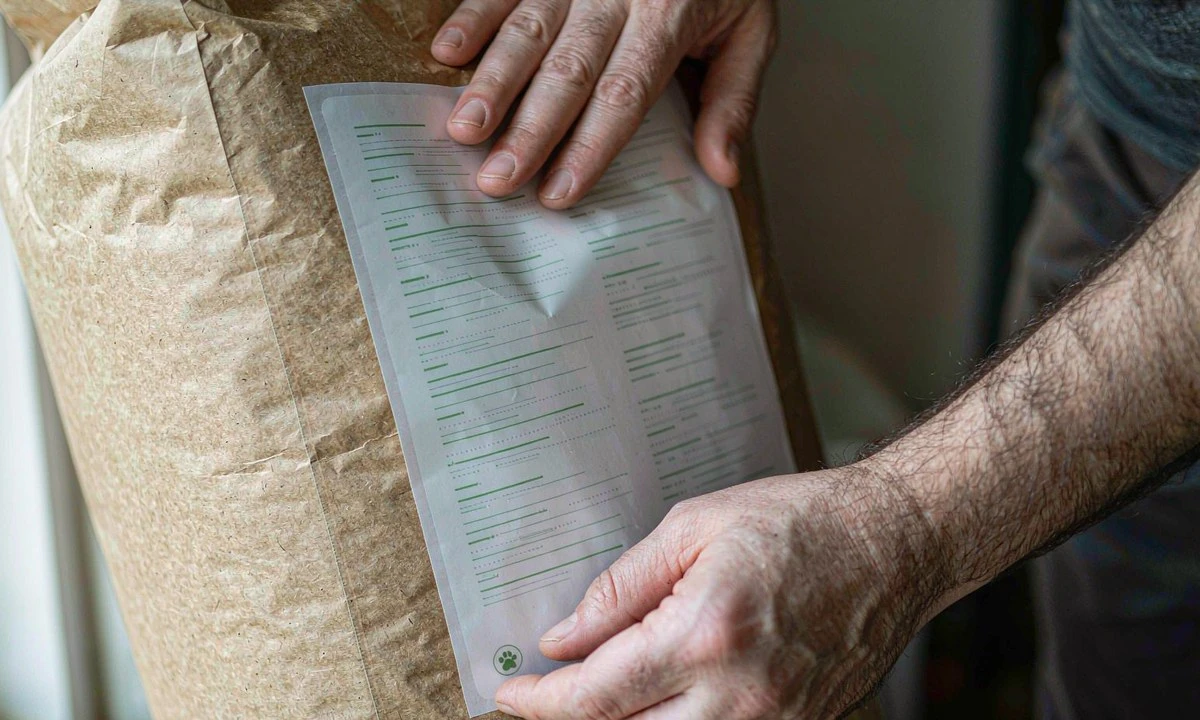
What belongs on the label, at minimum, for most markets:
- Product name and species / life-stage statement
- Guaranteed analysis or analytical constituents
- Ingredients in descending order of weight
- Feeding guidelines and transition advice
- Net weight, batch code, best-before date, and manufacturer or importer address
- Storage instructions and, where claimed, certification marks
In the United States, the model regulations for these statements are maintained by the Association of American Feed Control Officials; in the EU, labelling follows the feed marketing regulation and the FEDIAF code. Whichever market you sell into, get the artwork reviewed against the current text before plates are made - relabelling an existing run is far more expensive than a proof round.
Material choice matters as much as copy. Kraft and recycled paper surfaces are fibrous and slightly rough, so a permanent acrylic adhesive with a high coat weight holds better than a removable one. For bags that go into a freezer or a hot car, specify an adhesive rated for the temperature range, and test on the actual substrate rather than a generic paper swatch. Our overview of custom sticker labels for packaging compares face stocks and adhesives for paper, film and curved surfaces.
Print, Colour and Finishes
Pet food print tends to be either photographic and glossy, or flat and natural. Both are achievable on paper, but they are not achievable with the same process.
- Flexo is the economical choice for high volumes on kraft. It handles solid areas and line work well; fine gradients and small type suffer on uncoated stock.
- Digital makes sense below a few thousand units per SKU and for short-run seasonal flavours. It also allows versioning by batch.
- Gravure gives the best photographic reproduction on film laminates, at the highest plate cost.
- Finishes: a matte water-based varnish protects print and keeps the natural look; soft-touch lamination feels premium but blocks paper recycling and shows grease marks on a food pack.
Production Reality: Filling Lines and Seal Contamination
Most pet food bags are filled on vertical form-fill-seal equipment or on pre-made pouch lines. Both are unforgiving about one specific failure: kibble dust and fat in the seal area. A single pellet caught in the top seal creates a channel that leaks air, moisture and aroma, and the defect usually appears only after a week in a carton.

Specification choices that prevent it:
- Ask for a seal layer with a wide sealing window (at least 30 degrees C), so small temperature drift on the line does not produce weak seals.
- Specify a peelable or easy-open seal only if the filling line has a reliable dust extraction nozzle above the seal jaws.
- Confirm the bag's gusset depth against the filler tube diameter; a bag that is too tight wrinkles at the jaw and traps product.
- Run a burst test and a 24-hour dye penetration test on production samples, not only on the pre-production run.
- If the product is freeze-dried or high-fat, verify that the seal survives a drop test from 1.2 m at -18 degrees C.
Sustainability Claims That Survive Scrutiny
Pet owners are attentive readers, and packaging claims are audited by competitors as much as by customers. Three rules keep a paper-forward story honest.
- Describe the layers accurately. "Kraft paper bag" is fine; "plastic-free" is not, if the structure contains a PE seal layer.
- Back fibre claims with certification. FSC chain-of-custody documentation should cover the actual paper grade used, and the certification code must match the printer's licence.
- Be specific about recyclability. A mono-material PE pouch may be recyclable in store drop-off schemes; a kraft / foil / PE laminate is not recyclable in either paper or plastic streams.
Food-contact compliance is a separate axis from sustainability, and in the US it is regulated through the Food and Drug Administration's food contact substance framework, summarised at FDA Food Ingredients and Packaging. Ask your converter for a declaration of compliance covering the inks, adhesives and coatings that touch the food, not just the substrate.
Where the Money Goes
A pet food packaging budget splits roughly into substrate, printing, closure hardware, and freight. The decisions with the most leverage:
| Decision | Cost Effect | Practical Guidance |
|---|---|---|
| Stock bag sizes | Removes tooling and plate cost | Standard 1 / 3 / 5 kg dimensions run on most fillers |
| Window size | Film and patching add cost | Keep under 40 percent of the front panel |
| Print process | Flexo to digital spread is 2 - 3x | Digital below ~3,000 units per SKU |
| Closure type | Slider roughly doubles zipper cost | Reserve sliders for 5 kg and senior-friendly packs |
| Structure | Foil adds 15 - 30 percent | Only specify foil where shelf life genuinely requires it |
A Specification Checklist
Before requesting quotations, have these numbers ready. Every one of them changes the price or the tooling.
- Fill weight and bulk density of the product, plus the target bag dimensions when filled
- Required shelf life and the storage conditions it must survive
- Sales channel: shelf, hook, e-commerce, or bulk pallet
- Print process preference and the number of SKUs per artwork
- Window size and position, if any
- Closure type and whether the pack must be resealable
- Market and the labelling regime that applies
- Certification requirements for fibre and food contact
Bringing the Pack Together
A sensible first range for a growing pet food brand looks like this: a kraft stand-up bag with a 30 percent window and a wide-track zipper for the 1 kg and 3 kg core SKUs, a plain kraft sack with a reinforced handle for the 10 kg bulk line, a window carton for treats, and a paper tube for the gift and subscription tier. Print the bags in one flexo run with a shared colour set, and use labels for flavour variants and batch-specific legal text. That combination keeps tooling low, keeps the shelf look consistent, and leaves room to move to digital or a second structure as volumes grow.
The details that decide whether the pack works are unglamorous: a window that does not tear at the corners, a seal that survives kibble dust, a label adhesive that holds on kraft, and legal text that is current for the market you ship to. Get those four right and the packaging stops being a cost line and starts doing the selling.